Lately I have noticed that a number of colleagues no longer use the definite article "the" when referring to the church. In fact, at last evening's meeting of our presbytery the majority of references to the church were to "church" rather than "the church". People spoke of "doing church" and "being church" as they sought after language to express the future of the church. I am wondering about the reasons for this shift in language. What does it seek to express? What gains or losses are there in dropping the specificity that is provided by the use of the definite article?
I am no expert in English grammar but I sense that the loss of "the" from church turns the noun into a verb. It is now not a place or an institution so much as it is an activity. "Doing church" reminds me of "doing lunch". There is something about this that feels right. The church is more a social movement - a Jesus movement - than it is a location. The church is a people whose life is marked by the ways of life that it is learning to practice. Since the name for God in Hebrew - YHWH - is a verb ("I am up to what I am up to") it seems fitting that God's people would also be know by what they are up to, what they are doing and being.
Yet if there is something to be gained by this seemingly minor shift in language there is also something to be lost. I notice that when we speak of "doing church" that the word church becomes synonymous with "faith community". It feels more generic, less specific. Harder to pin down, more nebulous. Now the focus is on a way of being together and not on which particular church we are speaking of. My friend Doug reminds me that the official name of The United Church of Canada includes the word "The" with a capital "T". When we speak of "The Church" we are talking about The Church of Jesus Christ. I hunch that it is becoming fashionable to drop the definite article when referring to the church because we are increasingly uncomfortable with being at home in the ecumenical church of Jesus Christ across the generations and across divergent theological and denominational locations. We notice all of the trouble that comes with the flawed witness of the church. We hope that we can somehow escape the trouble by freeing the idea of "church" from all the problematic specificity of being the church that has a history and a location and an identity. Well, maybe I am overstating the case but, after all, it's scribbling.


2/22/11
the poetics of scriptural discourse
"True theology is a matter not of marshalling formal arguments more clever and subtle than those of one's opponents, but of grasping the poetics of scriptural discourse and letting it make a better person of you."
- Brian Gerrish ("Grace and Gratitude", p. 17)
- Brian Gerrish ("Grace and Gratitude", p. 17)
2/16/11
truth telling and trouble making
In yesterday's post on being radical I noted that the word "radical" comes with pre-existent positive or negative voltage and I noticed that the word often suggests either truth-teller or trouble maker. Soon two responses came - from Peter and from Lorraine - reminding me that those are not necessarily opposites but that truth-telling regularly makes trouble! Yes. Truth-tellers in families and in churches and in nations break open systems stories and secrets. In doing so they cause trouble - especially for those who benefit from the way things are and from keeping the secret.
I wonder how to know when trouble making is the result of truth-telling and when it is simply harmful. Not all trouble making is the result of truth-telling. Sometimes it is just mischievous. Nor does all truth-telling cause trouble. There are times when a troubled situation or soul breaks through from confusion to clarity when the truth is told. I see it when tears of recognition and affirmation appear in response to a sermon or a gospel word shared in conversation.
Yet the gospel never encounters us without causing trouble. I recall Will Willimon's assertion that the three point sermons of his childhood were always one point short of the truth. Those sermons followed a threefold plot: 1. You are a sinner. 2. You have a problem. 3. Jesus is the answer. But, notes Willimon, there is a final point which too often goes unsaid: 4. Now, you really have a problem!
I wonder how to know when trouble making is the result of truth-telling and when it is simply harmful. Not all trouble making is the result of truth-telling. Sometimes it is just mischievous. Nor does all truth-telling cause trouble. There are times when a troubled situation or soul breaks through from confusion to clarity when the truth is told. I see it when tears of recognition and affirmation appear in response to a sermon or a gospel word shared in conversation.
Yet the gospel never encounters us without causing trouble. I recall Will Willimon's assertion that the three point sermons of his childhood were always one point short of the truth. Those sermons followed a threefold plot: 1. You are a sinner. 2. You have a problem. 3. Jesus is the answer. But, notes Willimon, there is a final point which too often goes unsaid: 4. Now, you really have a problem!
2/15/11
on being radical
I am not sure what to think of the word "radical" these days. It comes up often in conversations about the church. It can mean "new", "different", "challenging", "left-wing", "progressive". Yet its root is, in Latin, literally "root". Radical surgery is not a band-aid solution. It gets to the root of the illness. A radical church may look new to those who are accustomed to a domesticated church but if its life is truly rooted in Jesus Christ then its radical attributes are actually conservative in nature. To desire to be a radical church is to engage in an act of conservation of the original root stock in order that it may come to flower once again. The question that perplexes me these days is how to tell the difference between the gold that is a church rooted in Jesus Christ and the fool's gold of a church that is rooted in false gods who cannot deliver on false promises.
"Radical" is one of those words that comes with pre-existing voltage. For some it is an inherently positive word, for others always negative. We hear "radical" and imagine either truth-teller or trouble-maker. I wonder if it would help us to unplug the voltage and to listen with more care to one another as we explore the roots of Christian community in a post-Christian society. Can we agree that we are seeking to be rooted together in Jesus Christ? If not, then we need to discover what common root we share. If so, then we are not split into camps who are either for or against being a radical church. Rather, we have differing visions of the kind of tree that grows from such odd rootstock. And to be debating what it is to find our lives rooted in Jesus confirms that we are in this rooted church together. In an age of warring ideological encampments on the right and on the left this deep familial bond is, itself, a radical way of life.
"Radical" is one of those words that comes with pre-existing voltage. For some it is an inherently positive word, for others always negative. We hear "radical" and imagine either truth-teller or trouble-maker. I wonder if it would help us to unplug the voltage and to listen with more care to one another as we explore the roots of Christian community in a post-Christian society. Can we agree that we are seeking to be rooted together in Jesus Christ? If not, then we need to discover what common root we share. If so, then we are not split into camps who are either for or against being a radical church. Rather, we have differing visions of the kind of tree that grows from such odd rootstock. And to be debating what it is to find our lives rooted in Jesus confirms that we are in this rooted church together. In an age of warring ideological encampments on the right and on the left this deep familial bond is, itself, a radical way of life.
God in your own image
"You can safely assume you've created God in your own image when it turns out that God hates all the same people you do."
- Anne Lamott
- Anne Lamott
2/10/11
sweeter than honey
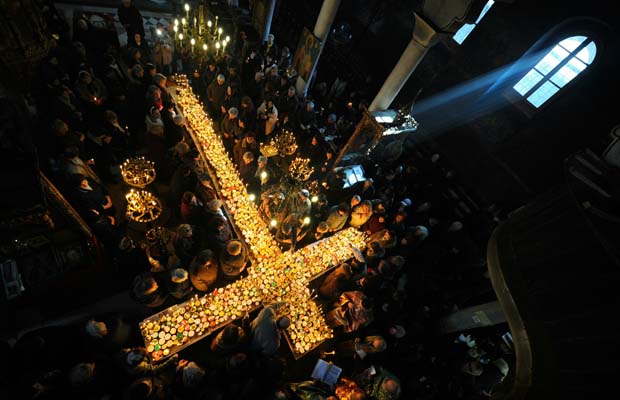
"How sweet is your word on my tongue, sweeter than honey in my mouth."
Psalm 119:103
People gather around a cross shaped by candles placed on jars of honey in the presentation of the Blessed Virgin church in Blagoevgrad on February 10, 2011, during a celebration in honour of St. Haralampi, protector of the beekeepers.
2/8/11
the toughest evangelistic task
"The toughest evangelistic task we have as preachers is not how to make Jesus make sense in a disbelieving modern world, but whether, when he meets us in our world, as we believe that he does, we will follow him or not."
- William Willimon ("Peculiar Speech: Preaching to the Baptized", p. 93)
- William Willimon ("Peculiar Speech: Preaching to the Baptized", p. 93)
Subscribe to:
Posts (Atom)